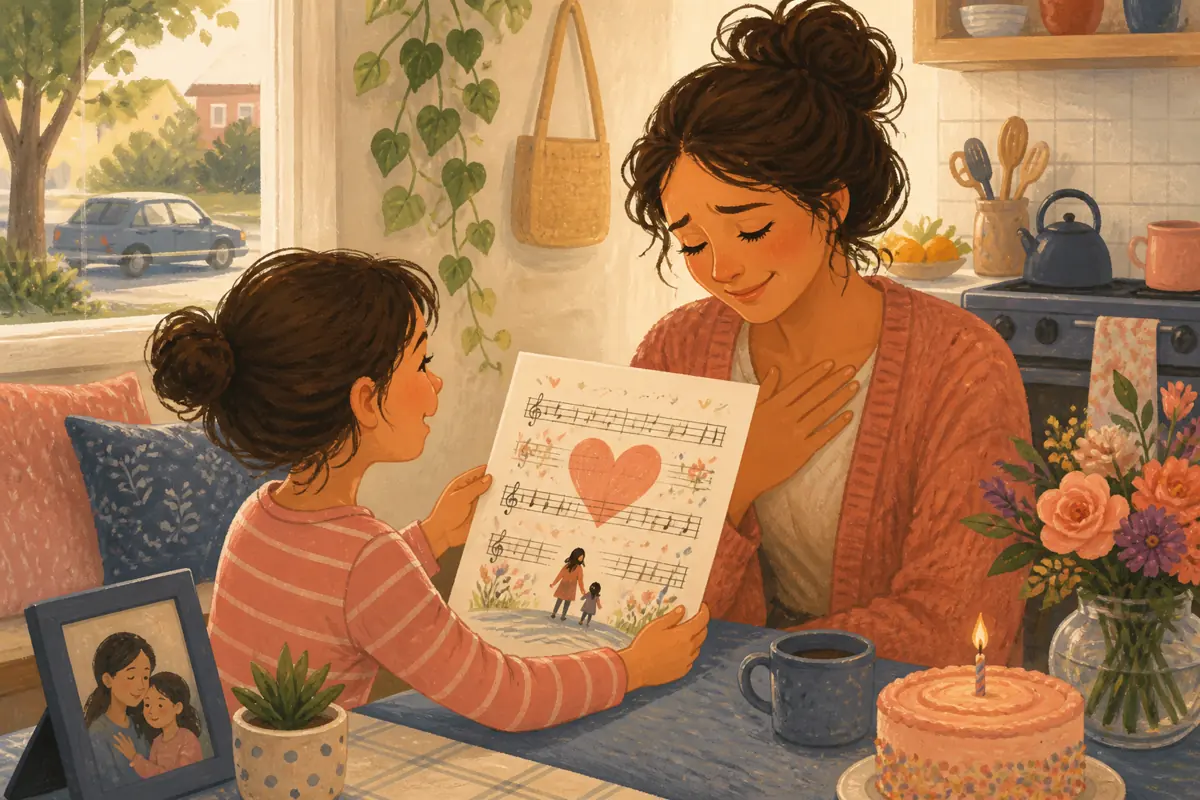
The direct answer for birthday recognition
The central decision is to connect one routine from earlier years to something you appreciate about her now. This keeps the article focused on birthday recognition instead of drifting into generic gift advice.
Write one plain sentence that states the reader’s desired outcome before collecting more material. For this topic, a useful version is: “I understand this familiar act differently now, and I am grateful for the care behind it.” That sentence becomes the standard for every example, edit, and musical choice. If a detail is interesting but does not support that result, keep it in notes rather than forcing it into the song.
The most useful starting evidence is the school-morning drive, a repeated kitchen phrase, or the way she still checks in before a big day. Describe who was involved, what happened, and why it matters now. This moves the work from an abstract preference to a decision that another person can understand and adapt without inventing a story.
Work through a specific example
An adaptable example shows how the recommendation works without pretending a fictional customer is real. Use it as a pattern, then replace every detail with facts from the actual relationship or project.
Suppose the useful raw material is the school-morning drive, a repeated kitchen phrase, or the way she still checks in before a big day. First write the event in ordinary prose. Next identify what the event demonstrates. Finally connect that observation to “I understand this familiar act differently now, and I am grateful for the care behind it.” This order keeps the conclusion attached to evidence instead of asking rhyme, melody, or production to create meaning that the brief never supplied.
Try a second version that changes only one choice, such as point of view, order, tempo, audience, or format. Comparing controlled alternatives makes the tradeoff visible. It is more useful than changing lyrics, genre, arrangement, and delivery at the same time and then guessing which change improved the result.
Gather the right input before deciding
Good birthday recognition depends on accurate, bounded input. Collect only the facts, examples, permissions, and listening preferences needed for this specific job.
Begin with one recent example and one older example, then compare them. The contrast often reveals what changed, what stayed dependable, or which message deserves the chorus. Write down names and phrases exactly as people say them, but mark any detail that needs pronunciation help, factual confirmation, or consent before it can appear in audio.
Recognition matters more than drama. Birthday recognition improves when the chosen material can be pictured quickly and explained literally. Broad praise such as “you are always there” needs an observable action before it belongs in a lyric or decision.
- One concrete scene or use case
- One exact phrase or direct message
- One privacy or consent boundary
- One listening or sharing constraint
Make the musical or format choice serve the job
a style Mom already enjoys is useful only when it supports the words, audience, and setting. The label should never force the material into a stereotype.
Describe the needed qualities in ordinary language: space for detailed words, a steady pulse, restrained instrumentation, a clear lead vocal, or enough contrast for a short hook. Avoid imitating a named living artist. The recipient’s listening habits and the intended playback setting are stronger evidence than the giver’s idea of what the occasion should sound like.
If two options seem plausible, keep the lyric and message constant while comparing only the format or musical direction. Listen for intelligibility, comfort, and fit. A technically impressive choice is not automatically better if it makes the personal detail harder to hear or changes the tone of the relationship.
Give every part one clear job
A reader should be able to follow the result on the first pass. The recommended workflow is to open in the older routine, show its present meaning, and use the chorus for a direct birthday thank-you.
Use a verse or setup for the concrete material, then let the chorus or decision statement express the larger point. If a bridge, extra verse, visual prop, or public reveal does not add a new job, leave it out. Length and complexity should follow the number of necessary ideas rather than a template that must be filled.
Test the outline aloud without music or presentation. If a listener would need background knowledge to understand who acted, where the scene happened, or why the choice matters, add that context directly. Do not rely on a clever line, an inside joke, or emotional delivery to repair missing information.
- Setup: establish the concrete situation
- Development: show what changes or becomes clear
- Core message: state the conclusion directly
- Ending: close with one present-tense action or wish
Avoid the failure modes specific to birthday recognition
The main boundary is to avoid calling her perfect, listing sacrifices you cannot verify, or making the song only about motherhood. These problems can make an otherwise polished result inaccurate, uncomfortable, or difficult to share.
Review the likely audience before submitting or publishing any personal material. Remove medical, legal, financial, conflict, precise-location, and third-party details unless they are necessary, consented, and appropriate for every expected listener. When the meaning matters but the fact is sensitive, preserve the safe meaning rather than the private fact.
Also check for emotional pressure. A custom song or related gift should not require an immediate reaction, public disclosure, forgiveness, agreement, or reciprocal promise. Give the recipient room to listen privately and respond later, especially when the topic involves romance, family history, grief, workplace roles, or health.
Plan the real-world test or first listen
Delivery belongs in the brief because the same content can feel different in a quiet private setting and a crowded public one. For this topic, listen together in a familiar room before the larger birthday gathering if she dislikes attention.
Test the full file, link, device, volume, and network conditions before the intended moment. Keep an offline or alternate access path when practical. Introduce the result with one uncomplicated sentence about why it exists, then let the recipient or reviewer hear it without a speech that explains every choice.
If the setting changes, use the safer backup rather than forcing the original plan. Moving from a public room to a private listen is not a failed surprise or gift. It is a deliberate way to protect intelligibility, privacy, and the recipient’s control over their response.
Run a final accuracy and usefulness review
The last pass should check whether the page and song brief answer the exact narrow question, support every material claim, and give the reader a safe next action.
Confirm facts, names, relationships, pronouns, timing, and the literal meaning of every example. Remove repeated conclusions, vague praise, and any sentence that depends on metaphor to make sense. Then verify that the central message still matches “I understand this familiar act differently now, and I am grateful for the care behind it” and that the title and description do not promise more than the article provides.
TopCustomSong’s methodology explains its editorial approach, and the linked Joybox page is the official source for current product information. Readers can enter an email in the shared article offer to receive a link to create a free 45-second song preview. The shared renderer supplies that single capture experience and preserves article attribution.
The editorial decision that makes this guide distinct
This guide is built around one narrow recommendation: connect one routine from earlier years to something you appreciate about her now. That choice determines which examples deserve space and which adjacent advice belongs on another page.
Test every paragraph against the article’s exact reader job and primary query. A useful detail must help the reader make, review, present, protect, or choose something related to birthday recognition. Remove a paragraph if it merely repeats that personalization matters without showing a decision, boundary, or adaptable example.
Apply the plain-language test to “I understand this familiar act differently now, and I am grateful for the care behind it.” The article must explain that idea through the school-morning drive, a repeated kitchen phrase, or the way she still checks in before a big day or another observable example. If a sentence requires interpretation, split it into the actor, action, and reason before approving the page.
Frequently asked questions
What is the first step for birthday recognition?
Start by writing one literal outcome sentence, then collect one concrete example that supports it. For this topic, the working message is “I understand this familiar act differently now, and I am grateful for the care behind it.”
How many examples should I use?
Use the smallest number that gives each idea a clear job. One or two connected scenes are often easier to follow than a long timeline, but the right number depends on what the message must explain.
What details should stay out?
Leave out material that is inaccurate, unnecessary, unconsented, or risky if the audio is forwarded. Also avoid calling her perfect, listing sacrifices you cannot verify, or making the song only about motherhood.
Can I test the idea before making a full song?
Enter your email in the article offer to receive a link to create a free 45-second song preview. Use it to judge the direction, clarity, tone, and essential details before moving forward.