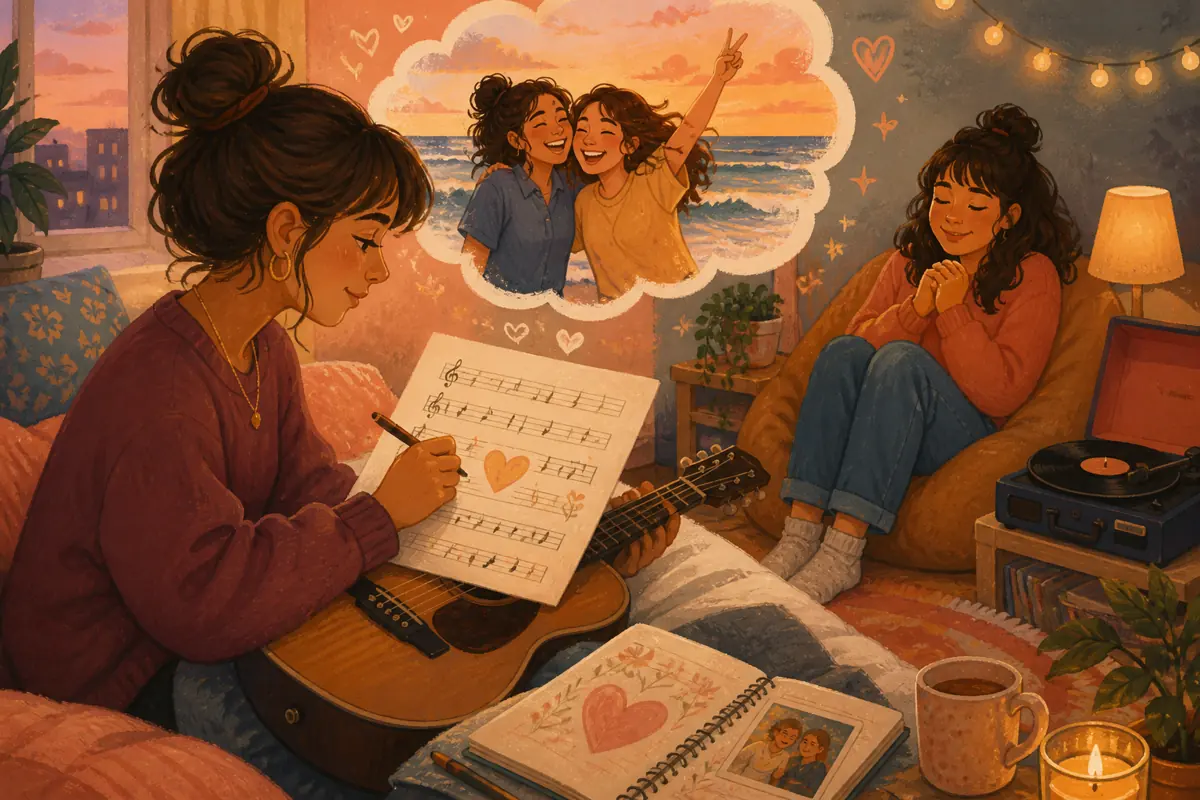
Start with one friendship thread, not the whole history
A meaningful custom song for a best friend usually has one central friendship thread supported by three to five well-chosen details. Instead of trying to fit every trip, joke, milestone, and difficult season into the lyric, choose the idea that explains why those memories matter together.
Before collecting stories, decide what you hope your friend feels when the chorus arrives. Perhaps you want them to feel recognized for being the person who always answers, proud of how far they have come, or reminded that ordinary time together has mattered more than either of you says out loud.
A useful thread might be that your friend became a version of home during a period of change. In that case, a late-night call, a borrowed suitcase, an inside joke from a new apartment, and their habit of checking in can all belong in the same song.
Use a short memory interview to find lyric-worthy details
Broad descriptions such as “funny,” “supportive,” and “like family” are true for many friendships, but they do not yet give a song its texture. A short memory interview helps turn those labels into scenes, habits, and language that could belong only to the two of you.
Write rough notes before worrying about polished sentiment. The aim is not to produce lyrics at this stage, but to gather material with both emotional and sensory value: where you were, what your friend did, what you noticed, and why the moment stayed with you.
Look for the extra layer beneath a reference. A diner name alone may not mean much, but the reason it matters might: it was where you made a reckless five-year plan, waited out rain after a concert, or ordered the same meal after every bad date.
- When did you realize this was more than a casual friendship, and what was happening then?
- What does your friend reliably do when you are stressed, celebrating, running late, or pretending you are fine?
- Which nickname, misheard lyric, shared phrase, or running joke would make them laugh right away?
- What place, food, route, object, or yearly ritual brings the friendship into focus?
- What challenge did you face together, and what did your friend specifically do that mattered?
- What future scene feels true to your friendship: a reunion, a familiar tradition, a new chapter, or another ordinary night together?
Give the song a shape before choosing every line
A simple song structure helps personal details feel intentional rather than piled together. It also creates a practical ranking system: the most important emotional point belongs in the chorus or bridge, while supporting memories can do their work in the verses.
A first verse often works best when it opens in a recognizable shared scene. That could be a school hallway, a car ride, a first apartment, a work break room, or a familiar weekend ritual.
The chorus should hold the central truth in language simple enough to return to. For a friend who has been a steady constant, the refrain might circle around the fact that they pick up the phone, know how to make a hard week lighter, or make an unfamiliar place feel known.
Match the genre and tone to how you actually relate
The right sound is not determined by the occasion alone. A birthday, reunion, or thank-you gift can be warm, funny, reflective, energetic, or a mix of those things; the better choice is the one that makes your shared memories feel believable.
A warm acoustic or folk-leaning direction can suit a friendship rooted in long talks, gradual growing pains, and dependable support. It leaves room for storytelling and gentle observations, such as a familiar street, coffee after a hard day, or a message that arrived at the right moment.
If your friendship runs on teasing, road trips, loud singalongs, or impulsive plans, upbeat pop or indie-pop may carry the story more naturally. Gratitude can still be present, but the energy should make room for the humor and forward motion that define your time together.
Keep private history private without making the song vague
A best-friend song can be emotionally candid without revealing information your friend would not want played around family, coworkers, or a wider group. Privacy decisions made early let you write with more confidence and protect the trust behind the gift.
Some memories matter because of what your friend did for you, not because the event itself needs to be named. Health experiences, breakups, family conflict, financial strain, legal matters, and private messages deserve particular care.
Think about the likely first-listen setting before finalizing sensitive references. A lyric that feels right during a private car ride may create discomfort at a birthday dinner if it identifies an old crush, a personal struggle, or an incident your friend has chosen to leave behind.
Adapt the idea to the kind of friendship you share
The same songwriting method can work for very different best friends because the emotional thread changes with the relationship. These examples are planning frameworks, not ready-made lyrics; replace every image with a scene that genuinely belongs to your history.
For a childhood or school friend, the song can explore the contrast between who you were and who you became. A verse might begin near lockers, a bus stop, or a bedroom floor covered in plans for the future, while the chorus returns to the idea that the friendship survived every version of you.
For a long-distance best friend, do not let miles become the entire subject. Start with the rituals that make distance less important: voice notes sent on walks, photos of the same kind of weather, calls that begin without a greeting, or an annual visit with the same first stop.
Make the first listen fit your friend, not the occasion
How you share the song shapes the gift almost as much as the lyric does. A thoughtful first listen does not need a big production, but it should give your friend enough comfort and space to take in something personal.
For a private, emotionally direct reveal, a walk, quiet dinner at home, or low-pressure moment after another activity can work well. Introduce it briefly rather than explaining every reference in advance.
A group reveal may suit an upbeat song with safe, recognizable references, but it is worth asking whether your friend enjoys public attention before making them the focus of a party or gathering. A tender song about a difficult chapter is usually better heard privately first.
A little practical preparation prevents the reveal from becoming distracted. Keep the listening link or file easy to access, test any speaker you plan to use, and avoid scheduling the first play during a rushed transition.
Use a final check to keep the song true to the friendship
Most weak best-friend songs go wrong by reaching for scale rather than accuracy. Before you finalize a brief, remove anything that competes with the central idea, creates an unnecessary privacy concern, or sounds unlike the way you and your friend speak to each other.
Avoid a chronological inventory of every year, roommate, trip, and milestone. History matters, but a list of facts rarely creates an emotional song.
Do not borrow language you would never use with this person. A friendship built on jokes can feel awkward under a completely solemn tribute, while a meaningful thank-you can get lost if every sincere feeling is buried under comedy.
Read the brief aloud before sharing it. If a detail would make you hesitate to hear the song unexpectedly around the people who matter to your friend, revise it, generalize it, or leave it out.
Sources and methodology
This page uses a recipient-specific editorial approach rather than making unverified promises about any custom-song provider. The guidance is designed for the practical choices involved in writing for one close friend: selecting memories, choosing tone, protecting privacy, shaping the lyric, and planning the reveal.
Primary sources consulted were TopCustomSong methodology at https://topcustomsong.com/methodology and the Joybox official site at https://joybox.studio/, both checked on 2026-08-12. This page does not state prices, turnaround times, delivery guarantees, policy terms, previews, or specific product capabilities because the supplied research packet does not provide verified details for those claims.
The original editorial contribution here is the best-friend-specific memory interview, the distinction between a memory and a recurring symbol, the structure-based method for ranking details, privacy guidance for shared history, adaptable friendship scenarios, and the first-listen plan. These elements address a two-person relationship dynamic rather than offering a broad personalized-gift overview.
This topic is distinct from general custom-song guidance because the recipient is a best friend. The decisions are different when shared language, inside jokes, long history, emotional calibration, and public-versus-private listening all matter at once.
Frequently asked questions
How many memories should I include in a custom song for a best friend?
Three to five well-chosen details are usually enough to make a song feel personal while preserving a clear emotional center. Choose one essential moment, two or three supporting scenes, and, if it fits, one recurring phrase or symbol that connects them.
Should a best-friend song be funny or emotional?
It can be both if that reflects the way you actually relate. A playful opening detail often makes a sincere chorus feel more natural, while a mostly humorous song can be the right choice when humor is genuinely how you show affection.
Can I mention a difficult time my best friend went through?
Yes, but focus on their support, resilience, or what the friendship meant without exposing facts they may not want shared. This matters especially if other people could hear the song. Describe what they did or how their presence changed things rather than naming sensitive circumstances.
What if my best friend and I do not have one dramatic story?
Ordinary rituals often make the strongest material because they show the texture of a real friendship. A weekly call, familiar meal, repeated saying, regular route, or the way your friend appears after a bad day can carry more meaning than one major event.
How can I try the idea before making a full song?
Enter your email in the article offer to receive a link to create a free 45-second song preview. The shared article popup handles that request, so there is no second form inside this guide.