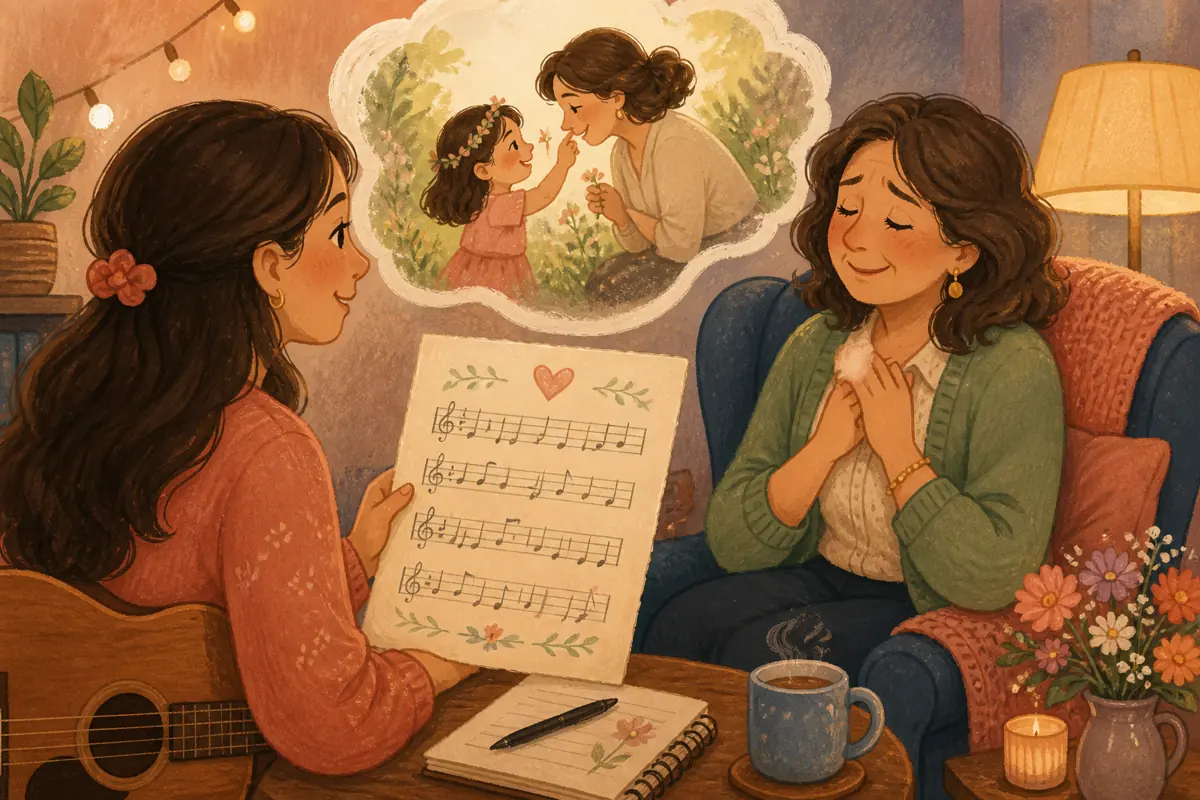
Start with one honest idea, not her entire life story
A strong custom song for a godmother usually centers on one role she has genuinely played: a steady guide, a joyful keeper of traditions, an encouraging presence, or family chosen with care. Let a few real memories support that idea instead of trying to fit every kindness, holiday, and milestone into one lyric.
The title “godmother” can mean very different things from one family to another. She may be a sibling, cousin, lifelong friend, faith-based sponsor, honorary aunt, or someone whose closeness has changed over time.
A clear central thought keeps a personal song from becoming a long tribute speech. If she is the person who remembers birthdays, makes room for everyone at the table, and calms a child before an unfamiliar event, those are not three unrelated facts.
Three memories are usually enough for a short, memorable song. Give each one one or two physical details—a place, an object, a phrase, a familiar sound, or a routine—so the lyric feels observed.
Find memories that show the relationship behind the title
The best memories are specific enough that they could only belong to your godmother and your family. Look for ordinary scenes, repeated rituals, and quiet gestures of care before reaching for major milestones.
Milestones matter, but they become more moving when they include a scene. “She came to my graduation” is a starting point.
It can help to sort your recollections by the part she plays in family life. Perhaps she preserves traditions, offers practical advice without making a fuss, brings humor into tense moments, or became family through friendship rather than blood.
When the gift comes from a child or celebrates her relationship with a child, use the child’s real scale of experience. A nickname, favorite snack, familiar game, or rainy-day routine will often land more naturally than formal language about devotion.
- What does she do at gatherings that everyone would recognize as hers, such as bringing a particular dish, starting a game, taking photographs, or checking that everyone gets home safely?
- Which ordinary or difficult day stays with you because of one particular thing she said or did?
- What phrase, joke, nickname, recipe, place, song, or ritual immediately brings her to mind?
- What has she taught you or your child without ever turning it into a formal lesson?
- What future moment would feel more meaningful because she is part of it?
Choose a musical tone that makes the memories believable
Genre changes the emotional meaning of a lyric, so choose it from her personality and the likely listening setting rather than from a generic idea of what a tribute should sound like. A restrained acoustic song, an upbeat pop track, and a warm soul-influenced arrangement can all hold gratitude, but they invite different kinds of listening.
A quieter acoustic, piano-led, or folk-leaning approach can suit a reflective thank-you, especially if the song will be heard during a calm dinner, a slideshow, or a one-on-one visit. These styles leave room for small details and can make the lyric feel like a personal note set to music.
A brighter pop, light country, or soul-influenced feel may better match someone who brings energy to reunions, turns the kitchen into a dance floor, or makes every birthday feel bigger. In that case, the memories can have more movement: cooking, laughing, road trips, games, and everyone gathering around her.
Emotional openness matters as much as genre. Some relationships comfortably hold direct language about love, faith, and chosen family. Others are better served by affectionate restraint, with a simple chorus and familiar details doing most of the emotional work.
Use lyric patterns as a frame, then replace every generic detail
Adaptable examples can help you hear how a memory might move through a song, but they should never stand in for your actual relationship. Keep the structure, then replace the setting, routine, and language with details that are true to her.
For a godmother who has been a steady guide, a verse can move from an early memory toward present-day gratitude. The pattern might sound like: “On the porch after school, you asked how my day had gone / You never rushed the answer; you stayed until the worry was gone.” A chorus can then name the larger meaning: “You made a place where I could be known / When I needed a steady hand, you helped me find my own.” The porch, timing, and concern should be swapped for your own real scene.
For someone at the heart of family traditions, build around a repeatable ritual. A line such as “Every December, flour on your sleeve / You turned the kitchen into something we believed” works because it gives the listener an image before it makes an emotional claim.
A song from a godchild can be simpler and more playful: “You know I like the blue cup, you save the biggest slice / You make the rainy Saturdays feel like a prize.” That scale of detail makes the chorus believable: “My godmother knows my laugh, my dreams, my favorite things / You make me feel so brave when I am trying out my wings.” If the child would not naturally say a phrase, revise it until it sounds like the relationship rather than an adult speech.
A practical outline is an opening verse with an earlier memory, a second verse with a more recent example of her care, and a chorus that explains what those moments mean. If there is a bridge, let it look gently ahead to the next birthday, holiday, school event, or family chapter.
Protect the parts of family life that do not belong in a surprise
Tasteful custom songs are defined partly by what they leave out. A godmother may be touched by a difficult memory, but she may not want private history, health information, family conflict, or another person's story revealed in a song—especially in front of a room.
If a hard season belongs in the song, acknowledge her care without retelling the event. A line about her being there when life felt heavy may preserve the emotional truth while protecting the details.
Religious language also deserves a deliberate choice. In some families, being a godmother is closely connected to faith, and a prayerful or spiritual tone may be deeply appropriate. In others, the title is primarily a family role.
Accuracy is a form of kindness when the relationship is warm but not intensely close. A meaningful song can honor her encouragement, generosity, and place in the family without claiming that she raised you, knew every chapter of your life, or was present at every turning point.
Give the first listen the amount of privacy it needs
The reveal is part of the gift. A private first listen is often the kindest choice for a reflective song or one that may bring out emotion, while a celebratory family gathering can suit a lighter song about shared traditions.
A private reveal gives her time to hear the words without feeling that she must react immediately. You might send the song with a short note saying that it was made for her to enjoy whenever she has a quiet moment.
A public reveal works best when the song is built for shared recognition rather than private disclosure. Before playing it, offer a sentence of context, such as, “We wanted to thank you for the way you have cared for our family.” Make sure the room is quiet enough for the words to be heard, and avoid pressing play while people are serving food, greeting one another, or talking over the introduction.
Listen through the final version yourself before sharing it. Check names, nicknames, pronunciation, factual details, and the overall emotional fit.
Sources and methodology
This is an original editorial guide for the specific task of creating a custom song for a godmother. It focuses on memory gathering, adaptable lyric structure, privacy boundaries, genre reasoning, and a considerate first-listen plan rather than general gift advice.
The supplied primary sources for this page were TopCustomSong methodology at https://topcustomsong.com/methodology and Joybox official product information at https://joybox.studio/, both checked August 17, 2026. The research packet did not provide verified information about pricing, turnaround times, delivery methods, previews, revisions, guarantees, or other provider policies.
The memory prompts, song outline, lyric patterns, privacy guidance, and reveal framework are original editorial tools created for this page. The lyric examples are illustrative templates, not customer stories, testimonials, or completed-song samples. They should be adapted only with truthful personal details.
This page is intentionally narrower than a general custom-song guide. Its purpose is to help a reader honor the particular godmother relationship without overstating closeness, exposing private family history, or treating a public reveal as the only meaningful way to give the song.
Frequently asked questions
What should a custom song for a godmother be about?
Build it around the particular way she has shown up for you or your child. A theme such as steady encouragement, joyful traditions, chosen family, or practical care becomes meaningful when it is supported by a few true scenes rather than broad praise alone.
Should the lyrics call her a godmother throughout the song?
Usually not. Using “godmother” once in an opening or chorus can clearly honor her role, but repeating the title in every section may sound formal. Her nickname, habits, routines, and shared memories will make the relationship feel more natural.
Can a custom song work if my godmother and I are not extremely close?
Yes. A respectful song can thank her for a real connection, encouragement, or meaningful family presence without inventing deeper intimacy. Keep the language proportionate to the relationship and choose details you know are true.
Is it better to play the song at a party or give her a private first listen?
Choose based on her personality and what the song contains. A private first listen is often more comfortable for reflective or sensitive lyrics. A celebratory song about shared traditions can work well at a gathering when it is introduced briefly and the room can hear the words.
How can I try the idea before making a full song?
Enter your email in the article offer to receive a link to create a free 45-second song preview. The shared article popup handles that request, so there is no second form inside this guide.