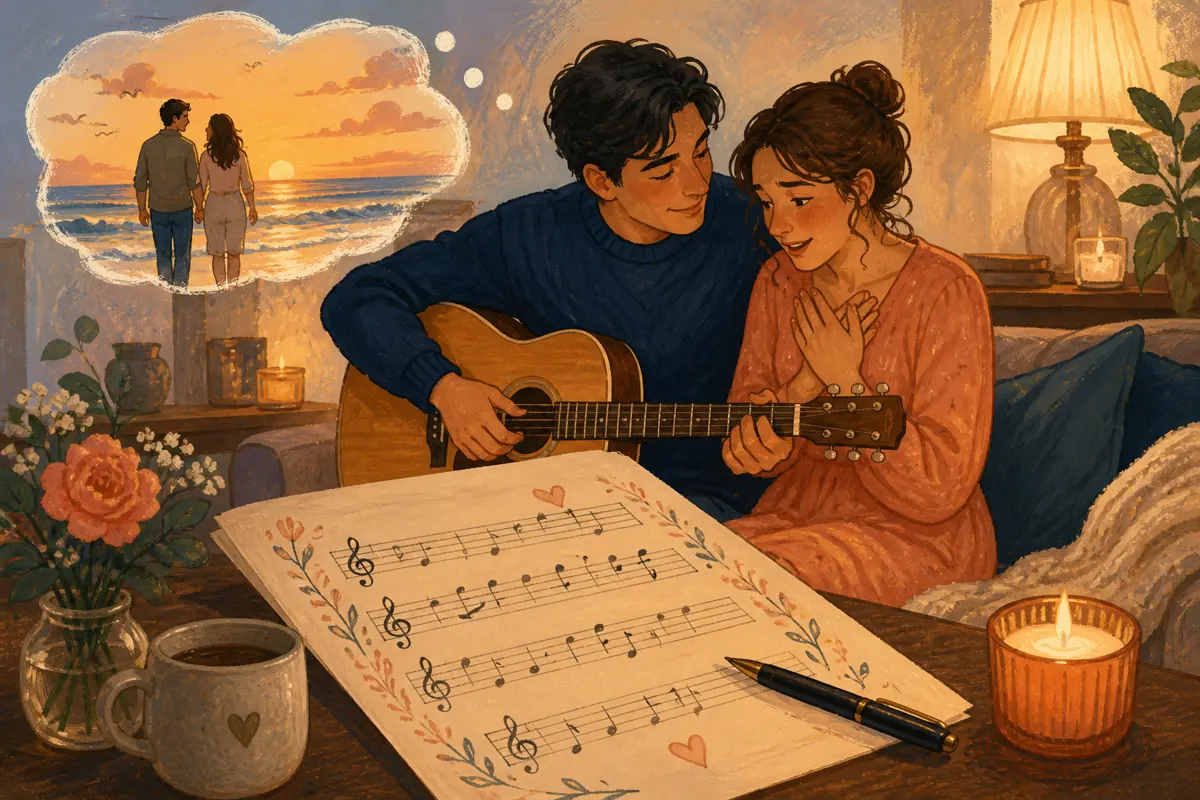
What makes a song for your partner feel genuinely personal
Build it around two or three details that could belong only to two partners marking an anniversary: show how the relationship changed through a few precise before-and-after moments.
The song will feel personal if the first verse includes a detail the recipient immediately recognizes, such as a family phrase, a familiar place, or a shared routine. The chorus can then build on that connection and express the larger message. Start with a scene, an action, or a phrase. Broad praise can still appear, but it should be supported by evidence: what happened, where it happened, and why the detail stayed with you. That gives the songwriter something concrete enough to turn into an image, a verse, or a recurring hook.
For this relationship, useful raw material includes the first ordinary date that became important later, the apartment, car, or kitchen from the early years, a difficult decision you made together, a private phrase that captures your teamwork, what daily life looks like now compared with the beginning. You do not need all five. Choose one detail for the opening, one for the emotional center, and one that points toward the future or the lasting effect of the relationship. A focused song usually feels more personal than a timeline that tries to mention everything.
- the first ordinary date that became important later
- the apartment, car, or kitchen from the early years
- a difficult decision you made together
- a private phrase that captures your teamwork
- what daily life looks like now compared with the beginning
A five-question memory interview you can answer in ten minutes
Answer in ordinary language. The songwriter needs accurate material, not polished lyrics.
Write one or two sentences for each prompt: When did this person surprise you? What ordinary routine would you miss? Which exact words sound like them? What did they teach or change? What do you want the listener to understand after the final chorus? If an answer sounds like something anyone could say, ask yourself for the place, object, date, action, or phrase that proves it.
Read the answers aloud before submitting them. Remove any detail you would not want played in front of the intended audience. Spell names phonetically when pronunciation is not obvious, and explain whether a nickname should sound affectionate, funny, or private. This small review prevents a technically correct lyric from creating the wrong emotional effect.
- Name the exact setting
- Describe what the person did
- Include one phrase they actually use
- Explain what changed because of them
- State the feeling without writing a rhyme
How to turn the memories into a song structure
Give each part of the song one job instead of packing every memory into every verse.
A reliable outline begins with a recognizable scene in verse one. Verse two can show what the relationship became or why the memory matters now. The chorus should carry the simplest emotional truth in language the recipient would accept. A bridge is useful only when it adds a change in time, perspective, or meaning; it should not repeat the same compliments with different rhymes.
One workable outline is: opening scene, a second specific memory, a chorus about the relationship’s meaning, a later-life or present-day scene, and a final chorus with one altered line. The altered final line is often more powerful than adding another verse because it shows that the story has moved somewhere.
- Verse 1: one scene
- Chorus: one emotional sentence
- Verse 2: what changed or endured
- Bridge: a new perspective only if needed
- Final chorus: repeat with one meaningful change
Choose genre and tone from the listener, not the occasion
The safest genre is one your partner already enjoys. For this page, useful starting points are soul or R&B for a warm romantic groove; acoustic pop for clear lyrics; country for a story that spans many years.
Genre changes how the same words are interpreted. A sparse acoustic arrangement places attention on names and memories. Country supports chronological storytelling. R&B can make a short repeated phrase feel intimate. Pop can keep a celebration moving. The label matters less than the requested tempo, energy, vocal character, and amount of lyrical space.
Give one positive direction and one boundary. For example: “warm acoustic pop, conversational vocal, hopeful rather than sad, with the names easy to understand.” Avoid asking for a direct imitation of a living artist. Describe the qualities you want instead: close vocal, bright drums, story-led verses, restrained piano, or a chorus that a family can sing back.
An example brief you can adapt without copying
Use the shape of this brief, then replace every example with your own facts.
Recipient and purpose: your partner; the relationship is two partners marking an anniversary. Central idea: show how the relationship changed through a few precise before-and-after moments. Opening detail: choose the most visual item from your memory interview. Emotional center: explain what that detail reveals about the person. Ending: say what you hope continues, what you now understand, or what you will carry forward.
Music direction: select one of these starting points—soul or R&B for a warm romantic groove; acoustic pop for clear lyrics; country for a story that spans many years. Delivery context: Play it after revisiting one of the places or meals named in the lyrics. Keep the full brief under a page. Specific, ranked details are more useful than a long unfiltered biography because they tell the writer which images must survive when the song is tightened.
Common mistakes and how to correct them
The biggest risks are retelling the entire relationship year by year; copying wedding-vow language that is no longer specific; making every line solemn when humor is part of the partnership.
Generic language is not automatically wrong; it becomes a problem when it is the only information available. “You were always there” improves when followed by the night, call, drive, meal, or task that demonstrates it. A list of adjectives improves when each verse earns one of them through a scene.
Also check emotional permission. A detail can be accurate and still be wrong for a public gift. Remove medical, financial, romantic, family-conflict, or childhood information that the recipient has not chosen to share. If the song touches grief or a strained relationship, favor honest, bounded language over a forced happy ending.
Final checklist before you request the preview
A two-minute fact and tone check protects the details that make the song valuable.
Confirm spelling and pronunciation, decide which three memories matter most, and identify anything that must not appear. Make sure the genre belongs to the listener and that the chorus message sounds natural in your own voice. Finally, decide whether the first listen should be private or shared. Play it after revisiting one of the places or meals named in the lyrics.
A short preview is useful for checking the direction: whether the name sounds right, the energy fits, and the central detail is recognizable. Treat it as a direction check rather than expecting every memory to fit into 45 seconds. If the emotional center is already clear, the full song has a strong foundation.
Frequently asked questions
How many memories should I include in a personalized anniversary song?
Start with three ranked memories. Extra details can help with context, but the writer should know which scene, phrase, and relationship change matter most.
Should the song be funny or emotional?
Match the real relationship. Humor and emotion can coexist, but choose which one should lead and give examples of the kind of humor or sentiment the recipient actually enjoys.
What if I cannot choose a genre?
Name two songs or general sounds the recipient already likes, then describe tempo, energy, and vocal character. Those directions are more useful than guessing a genre label.
How can I try the idea before making a full song?
Enter your email in the article offer to receive a link to create a free 45-second song preview. The shared article popup handles that request, so there is no second form inside this guide.